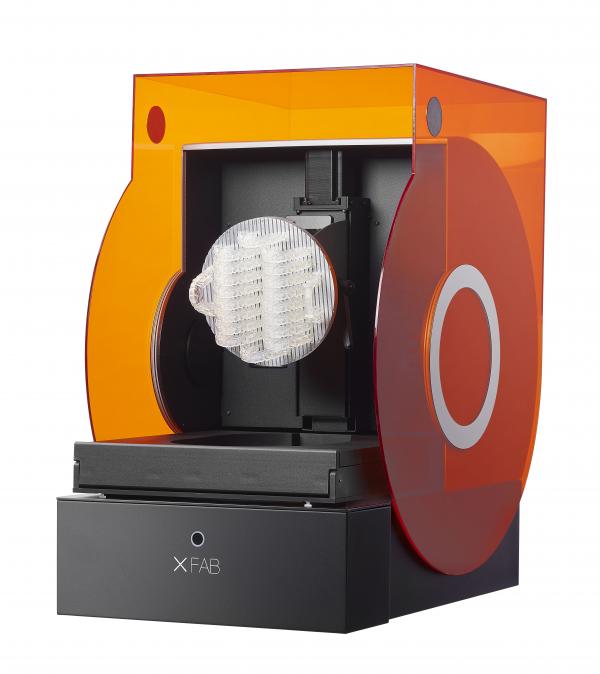
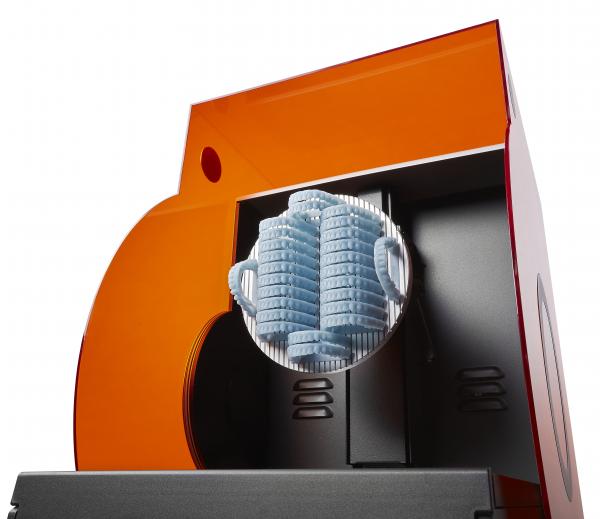
This is the XFAB model designed for dental sector’s professional applications.
Supplied with our Nauta®+ and Fictor® software, that allow manual setting of DWS material parameters, XFAB 2500PD guarantees complete freedom in optimizing settings when printing models.
Boasting a professional-grade resolution, XFAB 2500PD is the ideal solution for small and medium-sized dental laboratories that need premium quality.
Technology: Laser Stereolithography
Working Area: Ø 180×180 mm
Laser Source: Solid State BlueEdge®
Slice Thickness: 10-100 microns (depending on the type of material used)
Scanning Method: Galvanometer
Software: Fictor® XFAB Edition, Nauta®+ included
Input File Format: .stl, .slc, .nauta, .fictor, .mkr, .3dm, 3ds, .ply, .obj, .lwo, .x
Machine Size: 400 x 606 x 642 mm
Weight: 31 Kg
Operating Temperature and Humidity: 20°-25°C / 60%
Power Supply: 24V DC with AC 240/100V / 50-60 Hz external supplier included
Electrical Consumption: 160W
PC Minimum Requirements: Windows 8 or higher
Memory: RAM 4 GB
Graphics Card: OpenGL 2.0 compatible or above
I/O Interfaces: 1 USB port
Connectivity: 1 Active internet connection
FUSIA DC710 is suitable for direct casting of crowns and bridges in the dental field. It is easy to burn out with standard investments. FUSIA DC710 and XFAB 2500PD are also the right combination of materials and technology to achieve the best results in dental models for lost wax direct casting and pressed ceramic.
PRECISA RD096 is a nano-filled, gypsum-like material especially developed for the production of dental models designed directly from the intraoral scanning. The ceramic base allows to build parts with extremely smooth surfaces and really high resolution details, which makes PRECISA RD096GY perfect for models with removable dies and holes for analogs.
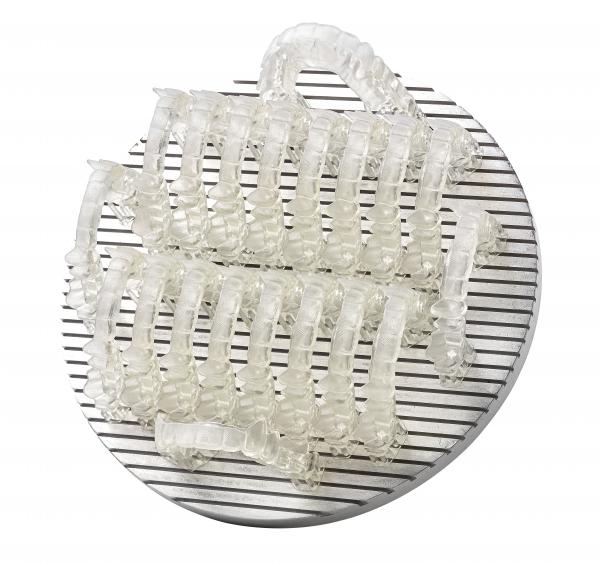
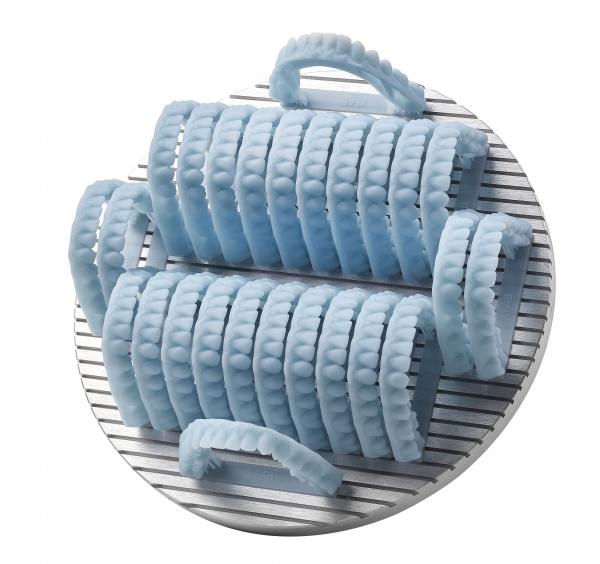
INVICTA 907 is a photosensitive material for DWS stereolithography 3D printers, designed for orthodontic applications. The opaque dark grey colour gives depth and detail to the surfaces. INVICTA 907 is impact resistant and long-lasting and resistant to thermal stress, which makes it perfect for the thermoforming of aligners. INVICTA 907 is the ideal material also for dental models and orthodontic arches.
THERMA 294 is suitable both for thin and thick models. It is the ideal material for the moulding. Models made of THERMA 294 are extremely smooth and precise. THERMA 294 is a photosensitive nanoceramic material for DWS stereolithography 3D printers, developed for thermal resistance tests, high definition models for vulcanized rubber molds and orthodontic arches for thermoformed aligners.
Temporis® is a photosensitive composite material for the custom fabrication of dental restorations such as inlays, bridges and crowns. Temporis® is a Class IIa CE marked medical device* for the fabrication of temporary inlays, crowns or bridges for longterm applications, up to the creation of a permanent restoration. To meet aesthetic and functional requirements, Temporis® is available in different colors and shades and can be easily shaped and polished.
Irix® Plus is a photosensitive hybrid composite material for the customized production of permanent restorations such as: inlays, onlays, veneers, single crowns and bridges up to three elements by stereolithographic 3D printing. Irix® Plus is a Class IIa CE marked medical device*. To meet aesthetic and functional requirements, Irix® Plus is available in different monochromatic shades and the exclusive adaptive gradient Photoshade.
The advanced 3D technology of DWS devices enables the printing of accurate, ready-to-use surgical guides by using Class I* DS3000 biocompatible material. The guides produced are stable and non-deformable, ensuring a faultless fit to the patient’s mouth to create the perfect conditions for a safe and eff ective operation.
DS3500 is a biocompatible Class I material, ideal for the print of individual trays. The printed objects, given the surface smoothness and accuracy, are suitable for all types of impression materials and grant an excellent fit. Their slight transparency is very useful in taking the impression in partial and/or total edentulism cases as it helps verifying the adhesion of the impression material to the mucosa. The printed trays are rigid, very stable and deformation-free.